Blades keeps a remote pilot's logbook the way EU operators fly: by category, by line of sight and by role. Everything stays on your iPhone, and the pages come out like a paper logbook.
Do you need a drone logbook?
Open category (A1, A2 and A3). No EU rule asks the remote pilot to keep a flight logbook. What you must carry is proof of your remote pilot competency, except with a C0 or another drone under 250 g in A1.
Specific category, including flights under the standard scenarios STS-01 and STS-02. The operator must keep an up-to-date record of its UAS operations, including any unusual technical or operational occurrences, of the maintenance done on its drones, and of the qualifications and training of its remote pilots, for at least three years (UAS.SPEC.050). EASA's acceptable means says that a logbook, which may be electronic, does the job, and that it should hold:
- the drone: manufacturer, model or variant, and serial number;
- the date, time and place of each take-off and landing, and the duration of each flight;
- the total flight hours or cycles;
- the remote pilot's name;
- the activity: the STS, or the number of the operational authorisation;
- any incident or accident, the pre-flight inspection, defects and repairs, and changes to the drone's configuration.
In the Open category a logbook is still the simplest way to show your experience, keep track of your drones, and have your records ready when you move up to the Specific category.
The categories in short
Everything in the Open category flies under 25 kg, in visual line of sight, no higher than 120 m above the closest point of the ground, and without dangerous goods or dropping anything.
| Subcategory | Where you may fly | Drones | Competency |
|---|---|---|---|
| A1 | Over uninvolved people with a C0 or under 250 g. A C1 should not fly over them. Never over assemblies of people. | C0, C1 and drones under 250 g | C0 and under 250 g: the manufacturer's instructions. C1: online training and exam |
| A2 | At least 30 m from uninvolved people, or 5 m in low-speed mode | C2 | Certificate of remote pilot competency |
| A3 | Away from people, and at least 150 m from residential, commercial, industrial or recreational areas | C2, C3, C4, and privately built or legacy drones under 25 kg | Online training and exam |
The Specific category covers what goes beyond this, under a declaration for a standard scenario (STS-01, STS-02) or an operational authorisation. The Certified category is for the operations with the highest risk.
Class marks
- C0: under 250 g. A1 (and A3).
- C1: under 900 g, or under 80 J on impact. A1 (and A3).
- C2: under 4 kg. A2 or A3.
- C3: under 25 kg and under 3 m across. A3.
- C4: under 25 kg. A3.
- C5: STS-01, in visual line of sight over a controlled ground area.
- C6: STS-02, beyond visual line of sight over a controlled ground area in a sparsely populated environment.
Competency
- A1 with a C1, and A3: an online training course and an online exam of 40 multiple-choice questions, with 75 % to pass.
- A2: the certificate of remote pilot competency. It builds on the A1/A3 training and exam, adds practical training you do yourself in A3 conditions and a declaration that you have done it, and ends with an extra exam of at least 30 questions, with 75 % to pass.
- STS-01 and STS-02: a certificate of remote pilot theoretical knowledge and an accreditation of the STS practical skill training.
- Certificates are valid for five years. The minimum age is 16, with some exceptions.
VLOS, EVLOS and BVLOS
- VLOS: you keep continuous, unaided visual contact with the drone, so you can control its path around other aircraft, people and obstacles (Regulation (EU) 2019/947, Article 2).
- BVLOS: any operation that is not VLOS.
- EVLOS is not defined in the regulation itself. EASA's guidance for the Specific category (SORA) describes it as flying with one or more visual observers who keep watch on the airspace, while you stay in direct control. It counts as BVLOS for the ground risk, and all VLOS requirements still apply.
Blades logs the time in each, and splits a flight between them when it uses more than one.
What you log in Blades
- Category. A1, A2, A3, Specific or Certified. The drone's C0–C6 class mark sets the category for you.
- Line of sight. VLOS, EVLOS and BVLOS, with the time split between them when one flight uses more than one.
- Your role. PIC, SIC, dual, instructor, RPIC, payload operator, mission commander, observer, safety pilot or examiner.
- The flight. Mission, location, departure time and flight time. Fly several in a session and log them on the same screen.
- Max altitude in feet or metres, with a warning above the 120 m limit of the Open category.
- Day or night. Auto night works it out from your location and take-off time (how night is defined).
- Private or commercial, and a second pilot or observer by name.
Your drones become cards in the fleet, with a photo, specs and the time flown on each.
Recency and certificates
Blades keeps track of the last 90 days for each category you fly, and keeps your certificates, including STS-01 and STS-02, in one place.
The logbook pages
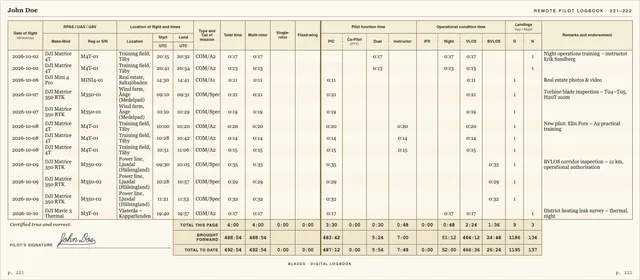
Every flight gets its own row in the Remote Pilot Logbook: multi-rotor, single-rotor or fixed-wing time, VLOS or BVLOS, and day or night landings, with totals carried forward from page to page. Export the pages as a PDF, or a CSV of every flight.
Bring your flights
Import CSV logs from DJI, Autel and other apps, or read a screenshot from DJI Fly, DJI Pilot 2, DJI GO 4, Autel Explorer, Litchi or AirData. Already have hours in another logbook? Enter your totals and carry on from there.
Importing and reading screenshots use the AI, paid in Blade-coins. You get 100 to start. Excel files can't be imported for drones yet; save them as CSV.
Private by design
- No account: open the app and log.
- Your flights stay on your iPhone, with an optional AES-256 encryption and a backup to your own iCloud.
- Logging, the logbook and exports work offline, out in the field.
Price
Free for 20 drone flights. In the drone logbook, imported flights count towards the 20. Premium is €2.99 a month for unlimited flights and 250 Blade-coins a month. Your flights stay yours either way: you can always open, edit and export them.
Questions
Do I need a logbook to fly in the Open category?
No EU rule requires one. Carry proof of competency where it is required, and keep a logbook for your own record.
How long must records in the Specific category be kept?
At least three years, under UAS.SPEC.050. Part of EASA's guidance still says two years, but the rule says three.
Can the logbook be electronic?
Yes. EASA's acceptable means for the Specific category says the logbook may be electronic.
Is EVLOS the same as BVLOS?
Not quite. With EVLOS you rely on visual observers instead of your own eyes. It is treated as BVLOS for the ground risk, but the VLOS requirements still apply.
Sources
- EASA Easy Access Rules for Unmanned Aircraft Systems: Regulation (EU) 2019/947 (Article 2, UAS.OPEN, UAS.SPEC.050 and its AMC) and Regulation (EU) 2019/945 (class marks)
- Regulation (EU) 2019/947 and Regulation (EU) 2019/945, the legally binding texts, on EUR-Lex
This guide sums up the EU rules as of October 2026. The rule text and your national authority decide.